If you’ve been to a cool new restaurant lately, chances are you’ve seen “Hen of the Woods” on the menu.
You may have thought to yourself, is it some kind of chicken?
It isn’t!
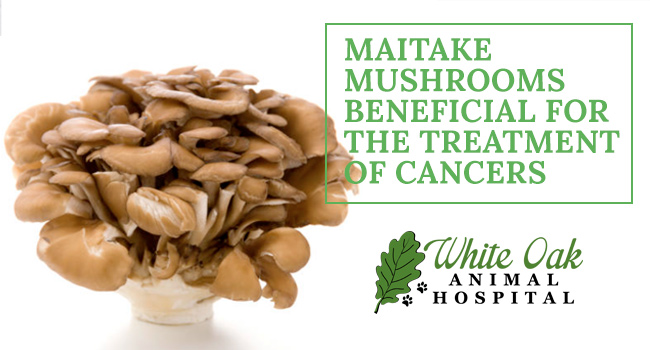
In fact, Hen of the Woods is a type of mushroom.
You may be more familiar with its other name, maitake mushroom.
While this is one of the most delicious mushrooms, it is also one of the most healthful.
And like many healthful foods found in nature, this one is also good for your pet.
What is a Maitake mushroom?
Maitake mushrooms are one of nature’s most healthful and powerful plants.
As we mentioned above, this incredible fungus is also known as “Hen of the Woods,” “Sheep’s Head (for its curious appearance),” and Grifola frondosa.
Maitakes grow at the base of oak, elm, and maple trees in Japan, China, and North America in the fall.
These wonderful mushrooms are so popular in Asia that people have been consuming them as medicine in Japan and China for thousands of years.
Because of its incredible healing properties, the Japanese call it a “dancing mushroom,” for the boost in energy people feel after consumption.
What is Beneficial About Maitake Mushroom for Dogs?
Dried maitake mushrooms are often used to treat:
- Blood pressure problems
- Immune function
- Side effects of chemotherapy
- Cold and flu viruses
- Blood sugar
- High cholesterol
Because maitakes contain polysaccharides and β-1,6-glucan, they are beneficial for cancer treatment.
Polysaccharides have been shown to regulate the immune system and promote health in human studies.
Animal studies support the use of this mushroom for cancer treatment, particularly its polysaccharide component, β-glucans, which are known to possess immunomodulatory properties.
In fact, one study revealed the maitake mushroom’s ability to enhance macrophages, natural killer cells, and cytotoxic T-cells.
The research showed maitake reduced tumor growth by 86% compared to untreated animals.
Another study demonstrated the mushroom’s immune-enhancing and anti-inflammatory properties, particularly boosting tumor-fighting abilities against syngeneic and allogeneic tumors.
In combination with Vitamin C, one study showed that maitake inhibited tumor growth and restored suppressed immune function.
According to the research, maitake mushrooms contain D-fraction, a polysaccharide that benefits human patients with bladder cancer, renal cell carcinoma, and breast cancer, among others.
Maitake mushroom contains:
- Beta-glucans
- Vitamins B, C, and D
- Antioxidants
- Amino acids
- Copper
- Potassium
- Fiber
Additionally, maitake mushrooms have very mild side effects, including the ability to lower blood sugar and blood pressure.
However, safety has not been proven in pregnant or lactating animals.
How Can You Administer Dried Maitake Mushroom For Your Pet?
While you could learn how to make a maitake mushroom tincture, we think giving your pet an easy-to-chew supplement is easier.
A supplement that includes other healthful mushrooms such as reishi, shiitake, and turkey tail would most effectively help your pup.
Seeking an all-natural supplement to boost your dog’s immune system?
Try PET | TAO Complement Immune. Complement Immune is a medicinal mushroom blend.
It also provides beneficial ingredients such as:
- N-acetyl-L-cysteine
- Vitamin C
- Coenzyme Q-10
- Selenium
- Vitamin A
- Vitamin E
More Interesting Studies on Miatake Mushroom
Maitake mushrooms have been widely studied for their immune-modulating effects, primarily due to their high beta-glucan content. Research shows these compounds activate key immune cells such as macrophages, natural killer (NK) cells, and dendritic cells, helping the body respond more effectively to pathogens and abnormal cells
In a phase I/II trial, maitake polysaccharide extracts demonstrated measurable effects on immune function in cancer patients, showing both stimulatory and regulatory activity. This suggests maitake may help balance immune responses rather than simply overstimulating them.
Additional studies have shown that maitake beta-glucans can enhance white blood cell recovery and function, particularly after immune suppression. For example, research found improved maturation of immune cells and increased leukocyte recovery following bone marrow injury, highlighting potential support during recovery or stress.
Learn more about PET | TAO Complement Immune.
Sources:
- Alexander, B., Fishman, A. I., Eshghi, M., Choudhury, M., & Konno, S. (2013). Induction of cell death in renal cell carcinoma with combination of D-Fraction and vitamin C. Integrative Cancer Therapies, 12(5), 442–448. https://pubmed.ncbi.nlm.nih.gov/23341484/
- Deng, G., Lin, H., Seidman, A., Fornier, M., D’Andrea, G., Wesa, K., Yeung, S., Cunningham-Rundles, S., Vickers, A. J., & Cassileth, B. (2009). A phase I/II trial of a polysaccharide extract from Grifola frondosa (Maitake mushroom) in breast cancer patients: immunological effects. Journal of Cancer Research and Clinical Oncology, 135(9), 1215–1221. https://pmc.ncbi.nlm.nih.gov/articles/PMC3751581/
- Lin, H., De Stanchina, E., Zhou, X. K., Hong, F., Seidman, A., Fornier, M., Xiao, W., Kennelly, E. J., Wesa, K., Cassileth, B. R., & Cunningham-Rundles, S. (2010). Maitake beta-glucan promotes recovery of leukocytes and myeloid cell function in peripheral blood from paclitaxel hematotoxicity. Cancer Immunology Immunotherapy, 59(6), 885–897. https://pmc.ncbi.nlm.nih.gov/articles/PMC3268513/
- Masuda, Y., Inoue, H., Ohta, H., Miyake, A., Konishi, M., & Nanba, H. (2012). Oral administration of soluble β‐glucans extracted from Grifola frondosa induces systemic antitumor immune response and decreases immunosuppression in tumor‐bearing mice. International Journal of Cancer, 133(1), 108–119. https://pubmed.ncbi.nlm.nih.gov/23280601/
- Singh, R. P., & Bhardwaj, A. (2023). β-glucans: a potential source for maintaining gut microbiota and the immune system. Frontiers in Nutrition, 10, 1143682. https://www.frontiersin.org/journals/nutrition/articles/10.3389/fnut.2023.1143682/full
- Svagelj, M., Berovic, M., Gregori, A., Wraber, B., Simcic, S., & Boh, B. (2012). Immunomodulating Activities of Cultivated Maitake Medicinal Mushroom Grifola frondosa (Dicks.: Fr.) S.F. Gray (Higher Basidiomycetes) on Peripheral Blood Mononuclear Cells. International Journal of Medicinal Mushrooms, 14(4), 377–383. https://pubmed.ncbi.nlm.nih.gov/23510175/